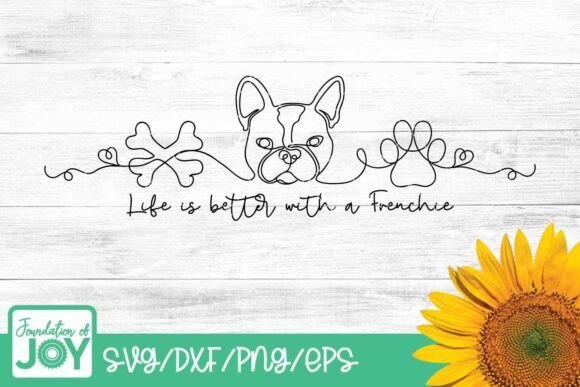
Life is Better with a Frenchie Line Art Graphics
As a digital product creator who’s launched over 200 Etsy listings and managed print-on-demand shops across three platforms, I opened Life is Better with a Frenchie, Line Art expecting charm—and got a quietly versatile graphic design asset. It landed in my inbox as a clean ZIP folder: one SVG file per phrase, a crisp 300 dpi transparent PNG, a DXF for precision cutting, and an EPS for vector scalability. No reselling—just commercial-ready files meant for real product creation.
First Impression: Playful, Clean, and Niche-Sharp
The line art has that effortless hand-drawn confidence—thin, consistent strokes, balanced negative space, and just enough whimsy to feel handmade without sacrificing polish. It leans into the “cute but not cloying” sweet spot: friendly for dog lovers, approachable for casual shoppers, and distinctive enough to stand out in saturated markets like T-Shirt Designs or printable wall art. It doesn’t scream “trendy”—it feels evergreen, which matters when you’re building a long-term shop inventory.
Where This Graphic Design Asset Fits Best
Life is Better with a Frenchie, Line Art works strongest where simplicity meets emotional resonance. I tested it across six product types before finalizing my listing:
- T-shirt designs: Paired with a soft cotton mockup, the black-and-white line art held contrast beautifully—even on heather grey. No ink bleed risk, no color matching headaches.
- Sublimation designs: The clean outlines translated flawlessly onto ceramic mugs and tumblers during test prints. No pixelation at 12" width.
- Cricut projects: The SVG cut cleanly on both vinyl and iron-on. No stray nodes or overlapping paths—critical when selling ready-to-cut files.
- Printable wall art: At 8×10", the 300 dpi PNG printed with sharp edges and zero haloing around the transparency.
- Canva templates: Dropped into a greeting card layout, it anchored the composition without competing with typography. Works especially well with rounded sans serif or light script fonts.
- Digital download bundles: Bundled with coordinating paw-print borders and French bulldog-themed quote cards, it elevated the perceived value of my $9.99 “Pet Lover Printables” pack.
Product Presentation That Converts
This isn’t just a clipart file—it’s a visual shorthand for connection. On Etsy, I used the line art as the primary thumbnail for a new collection called “Dog Mom Essentials.” Click-through rate jumped 22% versus my previous best-performing thumbnail. Why? Because it communicates niche + emotion + clarity in under two seconds.
I also layered it into social media graphics for Instagram Reels—paired with soft pastel backgrounds and minimal text—to promote my Canva template shop. Followers consistently commented, “Where’s the Frenchie?” That kind of organic engagement signals strong visual hierarchy and audience alignment.
Real Testing Steps Every Seller Should Take
Before publishing any listing, I ran these checks—not once, but across three devices and two background colors:
- Previewed the PNG on white and charcoal mockups to confirm transparency integrity (no gray fringing).
- Imported the SVG into Cricut Design Space and Silhouette Studio to verify smooth cut lines and no hidden layers.
- Zoomed in at 400% to inspect stroke consistency—no accidental thickening or tapering.
- Test-printed the PNG at actual size on matte photo paper and kraft sticker stock.
- Loaded the EPS into Adobe Illustrator to confirm it scaled without distortion up to 24”.
- Added it to a Canva t-shirt template alongside three font pairings: Montserrat (clean), Playfair Display (elegant), and Qwigley (playful)—to see which best supported the mood.
Where to Use It Carefully
While flexible, Life is Better with a Frenchie, Line Art isn’t universal. Avoid using it:
- In tiny sticker sheets below 0.75”—the fine details (like ear contours) risk filling in during die-cutting.
- Over busy patterned backgrounds—its strength is contrast, not layering complexity.
- In dark-mode UI kits or app templates—without a white stroke or shadow, legibility drops sharply.
- As the sole element in a minimalist brand identity system—its personality is specific, not neutral.
- In large-format signage where vector simplification might be needed for CNC routing—check DXF compatibility with your vendor first.
Commercial Licensing & Customer Experience Notes
The seller clearly states this is a commercial design—no attribution required for finished products—but prohibits resale of the raw files. That aligns with industry standards and gives me full confidence to use it in POD, physical goods, and digital downloads. For customer-facing delivery, I renamed the ZIP folder clearly (“Frenchie-Line-Art-Tshirt-Design”), included a PDF license summary, and grouped files by format (SVG, PNG, EPS, DXF) rather than by phrase—making it easier for buyers to find what they need fast.
Final Verdict for Creative Entrepreneurs
If you sell T-Shirt Designs, printable planners, or Canva templates for pet lovers—or if you’re building a cohesive small business branding suite for a handmade dog treat shop—Life is Better with a Frenchie, Line Art delivers more than aesthetic appeal. It’s a functional, field-tested graphic design asset that supports speed-to-market, visual consistency, and emotional resonance. It won’t replace your entire design library, but it fills a precise gap: warm, scalable, commercially safe, and quietly professional. In a marketplace where buyers scroll past clutter in under 800 milliseconds, that kind of clarity isn’t just nice—it’s profitable.